Outre-Lève – The village on the rock
Outre-Lève
The village on the rock

Here, where everything seems carved in silence, humans have learned to live with stone.
Outre-Lève is a village that speaks of the strength to dwell, despite adversity. Built entirely on a bluish-grey metamorphic rock – called péra beisa in the local patois – smoothed by ancient glaciers, this settlement appears to rise directly from the mountain itself.
A hard stone, difficult to work. Yet, with determination and skill, the people of the past built houses, barns, and storerooms here. They chose a central axis, like in medieval hamlets, to organize their shared life.
Among the most significant traces:
- A communal oven, sheltered by a covered entryway – a place of gathering and sharing.
- An 18th-century chapel, painted with images of protective saints:
- Saint Nicholas, the village’s patron;
- Saint Anthony, guardian of livestock;
- Saint Roch, invoked against epidemics;
- The Virgin Mary, quiet companion in daily toil.
Some beautiful wooden raccards (elevated granaries built on stone stilts) and granaries are still visible – elevated structures where people stored bread, threshed rye, seeds, traditional clothes, legal documents, and hay.
A precious heritage, kept safe and raised above ground.
From here, the view opens wide.
You can admire the lower, sunlit villages: Petit-Rosier, Grand-Rosier, Mellier, Coudreyt, Loré, and Vérana.
To the west lies another geological wonder: the ancient landslide of Li Ban, a deposit of massive boulders that slid down the valley after the last glaciations.
Among these rocks, now covered in rhododendrons and trees, are paths loved by climbers.
In the past, the caves formed between the boulders were used to store perishable food, like meat and cheese. Natural cold was the only way to preserve them.
Outre-Lève is a place that calls for respect and attention.
Here, the mountain teaches us that to inhabit is not to conquer, but to live in tune with what exists.
Walking among these stones is an act of listening.
A lesson in balance, carved in stone.
Listen to the story
Suggested activities for kids
Game: Things I’ve Never Seen
Draw 3 things you see here that you’ve never noticed before. They could be rocks, fountains, house details, ovens, flowers…
As you walk uphill to Carlantze, collect things like leaves, pinecones, bark or flowers. They tell you what’s living above you in the forest—maybe squirrels or birds! When you reach the houses, the climb is over. Draw what you found!
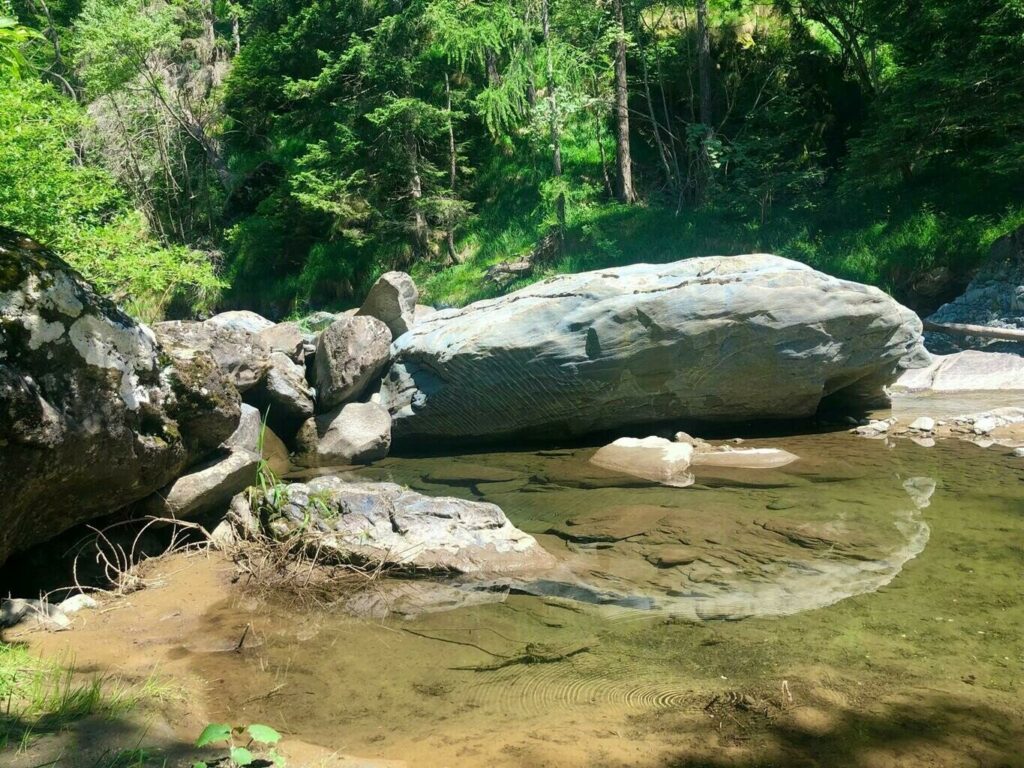
Be careful—some paths lead to pools along the Ayasse stream. They’re great places to rest if you need a break.
Suggested activities for adults
The rocks you see along Au fil de l’Eau are fascinating micro-ecosystems.
Have you ever noticed?
We often think of rocks as inert, lifeless. Yet, if we look closely, stone is rich with life forms.
Did you see the beautiful moss covering the large erratic boulders? Feel how soft and plush it is to the touch!
In cracks of big stones, small succulents like fern or Sempervivum (Houseleek) often grow—so much life!
Lichens are true rock colonizers: they live directly on stone, enduring harsh conditions. They even slowly break down rock to form soil over time. Did you know there are over 20,000 lichen species in nature, different in shape and color? Lichen is among the oldest forms of life on our wonderful planet Earth. How many will you find on Champorcher’s rocks?
Finally, large stones—like those here—are nature’s creations that might host imaginary forest beings. With careful observation, you might imagine some rocks as homes of “fairies” or protective woodland creatures.
They are mischievous, so best to befriend them—they may play small pranks if disturbed!